

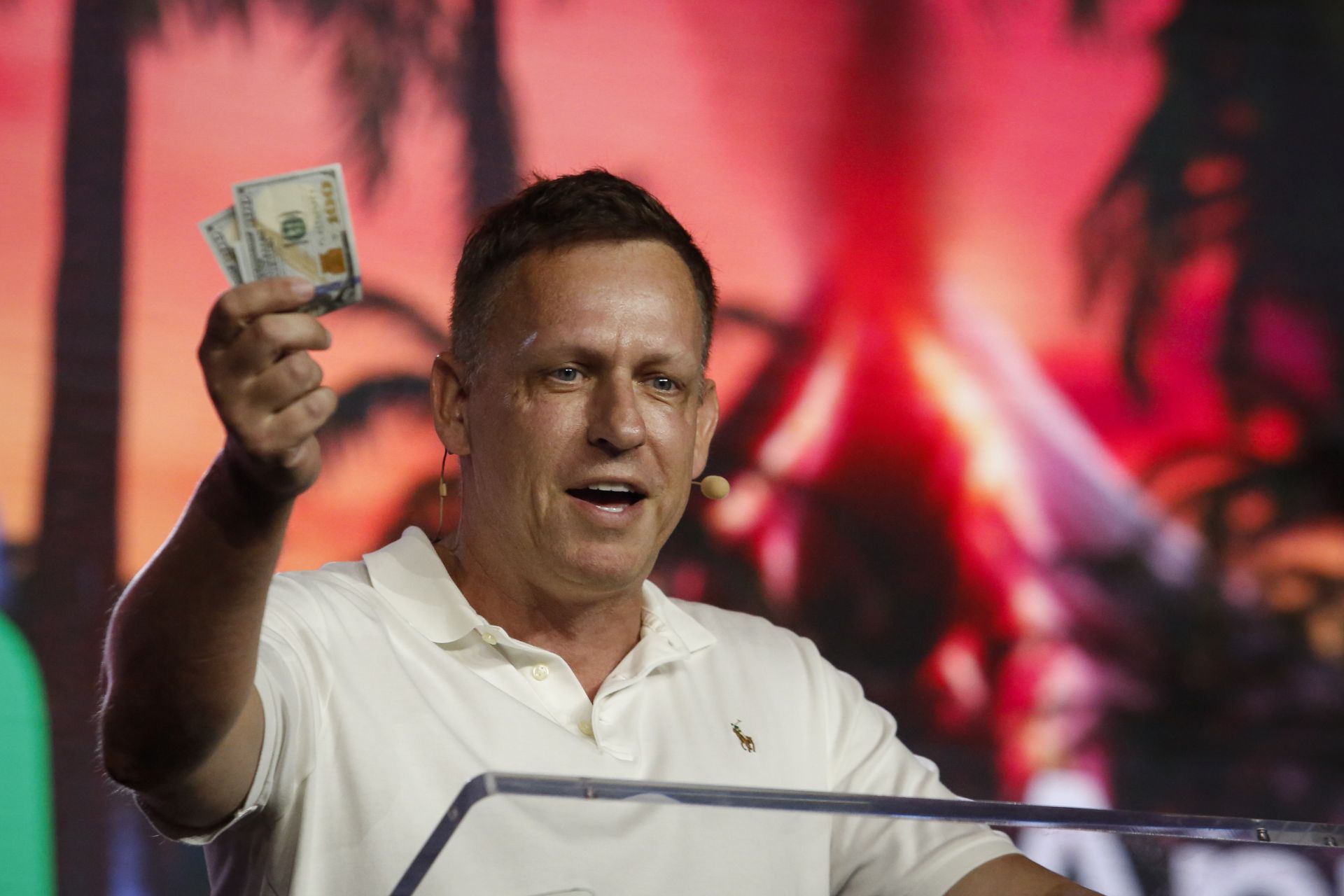
Javier Milei’s rise to power in Argentina has transformed the country into a laboratory for the global far right and tech capital. At the center of this convergence stands Peter Thiel, the billionaire co-founder of PayPal and Palantir, who has been living in Buenos Aires for just over a month.
Some commentators in the press and on social media have claimed that Thiel’s relocation represents a new flight of defeated Nazis to South America (though Thiel is not a Nazi, let alone a defeated one). Others suggest that his interest in the Southern Cone is due to fear of wealth taxes in California or a global collapse. Thiel’s arrival in Argentina is not, however, the product of paranoia, a mystical impulse or fascination with Javier Milei’s rhetoric; it is a logistical operation coordinated by a network of intermediaries, advisers and think tanks belonging to the transnational far right. And ultimately, it is part of a larger project of political and economic control.
After the end of World War II, many Nazi criminals escaped to South America — often with the covert support of local governments. None, of course, made it public; the Nazis had very bad press in Latin America in the postwar period. Among them, the government of Juan Perón (1946-1955) in Argentina attempted to recruit German scientists, much as the U.S. did with Wernher von Braun, a German-American aerospace engineer who was a member of the Nazi Party and one of the most important champions of space exploration in the 20th century. Perón’s attempt was a fiasco: Ronald Richter was neither much of a Nazi nor much of a scientist, though he managed to get Perón to finance a hydrogen isotope fusion energy project for several years, which was later revealed to be a hoax.
Far more serious was the case of SS officer Adolf Eichmann, a pivotal figure in the implementation of the “Final Solution,” who was abducted in Buenos Aires by the Mossad in 1960, taken to Israel, tried and executed. Over the years, the presence of Nazis in Argentina (and Brazil, Bolivia and Paraguay) turned the country into a sort of pop-culture metaphor for a criminal safe haven. When the Blue Meanies are defeated by the psychedelic Sgt. Pepper’s Lonely Hearts Club Band in the animated Beatles film “Yellow Submarine,” one of them asks, “Where can we flee? To Argentina?” The existence of a relatively significant German immigrant community in certain areas of Argentina contributed to the myth.
It is surely for this reason that a recent article in The Nation magazine begins by connecting Peter Thiel’s move to Argentina with that of Nazi criminals. Its author, David Futrelle, also jokes about the infamous escape of British criminal Ronnie Biggs to Brazil in 1964 (Biggs and 14 other men stole £2.6 million from the Glasgow-London Royal Mail Train in 1963). But Thiel is no train robber either; he is a German-born billionaire, naturalized as an American and later a New Zealander, who could become Argentine and, just in case, has also bought land in Uruguay. It is certainly an irony for a patron of JD Vance and the forces of “antiglobalist” nationalism to himself have citizenship in so many countries and be, in effect, a hyperglobal rootless cosmopolitan.
Futrelle dismisses the hypothesis that Thiel might be relocating for tax reasons. Instead, he suggests that Thiel and others with his level of wealth might be scouting for places in South America to flee to in case of natural disasters or nuclear apocalypse. And while Futrelle might be right that these “panicked peregrinations,” as he calls them, are not motivated by tax considerations, they might not be a matter of fear at all.
Italian economist Francesca Bria offered a more plausible interpretation in a November 2025 article for the Spanish newspaper La Vanguardia. There are no Nazis or bank robbers in her analysis, nor are there billionaires fleeing to paradise. What does exist — and is arguably much worse — is the construction of a techno-authoritarian complex consisting of a planetary surveillance infrastructure, of which Palantir’s recent contracts with the U.S. Department of Defense are a prime example (the Pentagon is expanding Palantir’s Maven AI as its core military system across service branches).
For Bria, those contracts — and the figure of Thiel himself — are representative of a global political-economic project: The authoritarian tech-right of Silicon Valley, Bria argues, does not merely fantasize about a new world; it is already building it. In that new world, democracy is no longer a normative political system, but an interface that can and should be modified, even if it retains the name as an illusion of continuity. Political authority exercised through democratic institutions is yielding to technical control exerted by private agents.
Bria observes these phenomena not only in the U.S., where Palantir’s contracts have placed digital control of warfare directly into the company’s hands. In Europe, while EU institutions debate digital control and social media use among youth, governments are transferring control of core state functions to Palantir — for instance, within the United Kingdom’s National Health Service (NHS), giving Thiel dominion over the medical histories of all British citizens. “The critical infrastructures of the state,” Bria observed, “are being replaced and reinstalled across five strategic domains — population data, monetary supply, defense, orbital communications and energy — which constitute the very foundations of democratic control.”
In short: Thiel and Palantir are positioning themselves to control nothing less than the operating system of the major Western powers. Concerns over the algorithmic organization of cultural consumption or political propaganda seem, at this point, like mere child’s play. This is neither a matter of criminals on the run, nor of tourism.
What, then, facilitated Thiel’s landing in Argentina? Behind the protocol greetings and official photos of the billionaire at the Casa Rosada (the Pink House, as the country’s executive mansion is known) operates a web of intermediaries directly linking Silicon Valley to Buenos Aires. Certain groups and individuals have been tasked with clearing the path, including local organizations integrated into the Atlas Network, such as Gerardo Bongiovanni’s Freedom Foundation; networks of influence like the International Foundation for Freedom — created by the late Nobel-prize winning Peruvian author Mario Vargas Llosa and led today by his son Álvaro; and central figures within the presidential inner circle, like adviser Demian Reidel and strategist Santiago Caputo (who act as local translators for the language of venture capital and tech security). These figures have built an institutional bridge so that corporations tied to the American “alt-right” can find state interlocutors eager to form a partnership with major tech leaders.
This web transcends ideological affinities. It reflects a geopolitical calculation about the exceptional material conditions that Argentina offers today: an experimental vanguard for a radicalized tech capitalism. The country has landed on the radar of Thiel and his partners as a low-cost laboratory with an abundance of critical resources.
What are those critical resources? First, Argentina presents a unique confluence of cheap energy and developing infrastructure. The expansion of fracking in the Vaca Muerta geological formation in northern Patagonia, home to one of the planet’s largest deposits of fossil gas, and the potential for large-scale energy generation hold out the promise of fuel for the most voracious industry of the digital era: high-intensity computing. Global data centers, the backbones of artificial intelligence and data processing for firms like Palantir, require a massive, continuous and above all deregulated energy supply. Argentina places that energy matrix on the table at fire-sale prices, coupled with a strategic reserve of nonrenewable natural resources like lithium and rare minerals, which are indispensable for global hardware infrastructure. Here, the Global South is no longer viewed merely as a provider of traditional raw materials, but as a more comprehensive base sustaining the cloud storage of the Global North.
The definitive factor binding this map together is that the Milei government is hell-bent on dismantling any control or regulation. According to the philosophy Thiel promotes, democracy is a bureaucratic obstacle that suffocates innovation; the ideal is a state managed like a private corporation, without unions, environmental regulations or fiscal interference. Under Milei’s libertarianism, Argentina offers itself as that very possibility. The absence of regulations, the flexibility of contracts and the unrestricted opening to foreign investment act as the institutional guarantees of an extreme experiment: The country stops behaving like a sovereign state to offer itself as a total free-trade zone — a testing ground to try out Silicon Valley utopias, from predictive espionage to the earliest iterations of privatized startup cities, with zero political and social cost to investors.

The New York Times recently reported that the Argentine government would love to offer citizenship to figures like Thiel. Milei’s chief of staff, Manuel Adorni, has declared that “all billionaires of the world who want to flee countries increasingly regulated, with higher taxes and governments that persecute their citizens, are welcome in the Argentine Republic, the new land of freedom.”
Thiel and Milei were introduced in 2024 at a meeting organized by Alec Oxenford, Argentina’s ambassador to the United States. Among Oxenford’s holdings is the e-commerce company OLX, which received funding from Thiel more than 15 years ago. “It was an anarcho-capitalist who met another anarcho-capitalist who is bringing things to life,” Milei said of the meeting. Meanwhile, the government’s head of social media, Juan Pablo Carreira, asserted in a social media post that Thiel “is already more Argentine than left-wingers.”
Another Argentine tech entrepreneur, Martín Varsavsky — a fan of Milei residing in Spain — reportedly built a nuclear bunker in the province of Mendoza in western Argentina. “The moment China takes Taiwan or Russia takes Lithuania, I’m in Buenos Aires,” he told the New York Times. “It’s good to have a Plan B for civilization.”
This would support the idea that Argentina is becoming a safe haven for billionaires. But it’s also noteworthy that the aforementioned Manuel Adorni is currently at the center of a massive scandal, having displayed personal and family expenditures that he cannot justify with his income. In his latest public appearance, while under investigation for enriching himself while in public office, he claimed that his small fortune came from an investment in bitcoin that he discovered on a misplaced pen drive. (Naturally, nobody believed him except President Milei himself.) In turn, Milei is being investigated for having promoted a cryptocurrency, $Libra, which turned out to be a monumental scam. In the midst of all this, the adviser Demian Reidel had to resign as president of a state-owned Argentine energy company, Nucleoelectrica, after massive personal expenses were discovered on a corporate credit card.
Did we say “safe haven for criminals”?
Thiel’s Argentine itinerary has been frenetic. In April, he met with President Milei and his minister of foreign affairs, Pablo Quirno; later with Luis Caputo, minister of economy, accompanied by his vice minister, José Luis Daza, and Santiago Bausili, the president of the Central Bank of Argentina. In his mansion, he organized a social gathering with local economic elites, with whom he discussed his obsession, the Antichrist. He also made time for his passion for chess at a locally famous, albeit small club called Torre Blanca, where he played a tournament, securing third place.
The latest surprise Thiel offered to the Argentine press was a private meeting with a leading progressive politician, Juan Grabois, with whom he reportedly discussed Pope Leo XIV’s recent encyclical on AI. Thiel invited Grabois, a Catholic and a close friend of the late Pope Francis, to his mansion. The Argentine left argued that Grabois’ Peronism and Catholicism outweigh his leftism, and that he was providing a “humanist cover” for the far right. It is highly probable that the narcissism of both Thiel and Grabois has convinced them that they are major intellectuals destined to produce unforgettable debates in the style of Sartre and Camus, or Chomsky and Foucault — even though, so far, neither of them has produced any text of real substance or relevance. They are perhaps much closer to the debates between Elon Musk and Mark Zuckerberg, who once threatened to fight each other inside a cage in Las Vegas.
The same applies to President Milei: He is convinced that he is a heavyweight intellectual figure, rather than a mere political leader or a president in office. On one occasion, he claimed he was co-authoring a book with the aforementioned Demian Reidel, the former adviser indicted for corruption — a book he believed was destined to guarantee him the Nobel Prize in Economics, which would surely be offered to him simultaneously with the Nobel Peace Prize for Donald Trump. He calls himself “doctor,” though he holds no postgraduate degree whatsoever, but merely an honorary doctorate awarded by a far-right private university that does not offer doctoral programs.
Perhaps for this reason, Milei published an article in the Financial Times on June 3, co-written with his “Minister of Deregulation and State Reform,” Federico Sturzenegger (who does hold a doctorate from MIT), proclaiming that in Argentina “a fiscal surplus, combined with the world’s most sweeping deregulation programme, has returned the economy to a growth trajectory after 15 years of stagnation” and inviting tech companies to establish themselves there — even those not organized by human beings but by AI. To this end, Milei sent a bill to parliament to amend the law regulating commercial corporations. The bill defines an Automated Corporation as one that “develops its corporate purpose through autonomous algorithmic systems or artificial intelligence agents, without requiring employees in a relationship of dependency or human resources for its ordinary operation.”
Possibly the worst aspect of the Milei-Sturzenegger text is their invocation of the precedent of the Dutch East India Company of 1602, whose founding led to the creation of the limited liability company, a legal invention considered by Milei and Sturzenegger one of the “10 most consequential inventions in history.” For these heavyweight intellectuals, the Dutch East India Company’s relationship with colonialism and the enslavement of millions of human beings does not figure in the equation.
It certainly did for the author Yuval Harari, who responded to Milei and Sturzenegger on X, writing: “Last week, Argentina’s President Milei announced a new legal category for non-human corporations — companies run by #AI agents or robots. Like traditional corporations, they would be granted legal personhood. This could generate enormous new wealth, but very worryingly, it would also hand AIs an all-purpose key that grants access to our financial, economic and political systems.”
Although Milei typically adorns his responses to critics with foul language and accusations that his detractors are communist murderers, his rejoinder in this case was surprisingly respectful:
Dear @harari_yuval, so many thanks for engaging in this fascinating and transcendental debate. We are at a dawn of a new age, which places us, I believe, in a place not that different from the one you yourself described so well in ‘Sapiens’ and your other books: that time when humans used fictions to organize our collective work and profit from technology. Now we need more than ever all our intelligence to build the framework that will allow us to benefit from the amazing opportunities we have ahead. Already preparing my reply to see if we can appease your fears about the path I proposed last week!
For once, Milei backed down: Harari’s intellectual fame, even in far-right circles, proved superior to his own pretensions. Or perhaps being recognized as an interlocutor simply sent him into a narcissistic ecstasy.
As the journalist Chris Lehmann recently observed, the actors in these purportedly intellectual debates “all share an underlying worldview combining supreme personal self-regard with bouts of predator paranoia.” Between Peter Thiel’s apocalypse and Antichrist, or “Chaos Theory” by Robert P. Murphy — a slim anarcho-capitalist tract that argues for the total privatization of law enforcement and the courts, which Milei distributed to all his ministers during a special Cabinet meeting in May — there are no sophisticated arguments at play, but only colossal egos and predatory appetites. The problem is exactly that: the predatory nature of a deeply and avowedly antidemocratic form of capitalism. As Francesca Bria puts it, “Unlike traditional authoritarianism, which relies on mass mobilization and state violence, this system operates through technological infrastructure and financial coordination, making resistance appear not only difficult but architecturally obsolete.”
Milei’s Argentina would not be a mere refuge for tax evaders or a shelter from nuclear war. It is, quite possibly, a testing ground where the true apocalypse is being deployed.
Become a member today to receive access to all our paywalled essays and the best of New Lines delivered to your inbox through our newsletters.


