

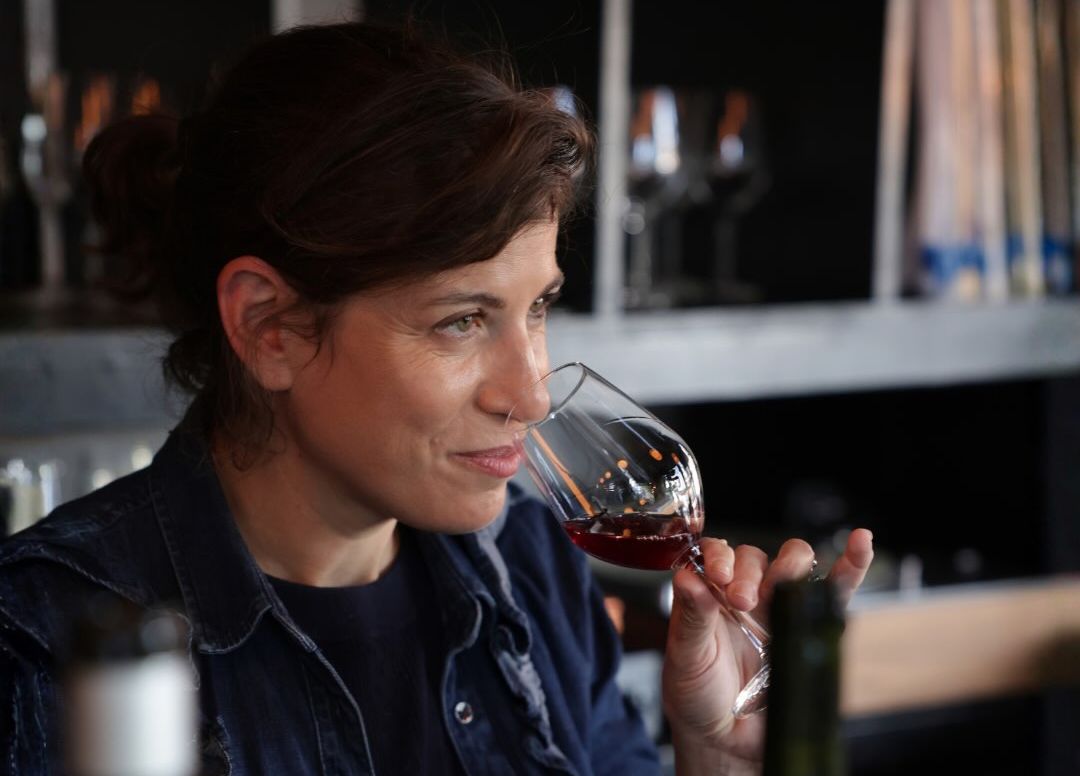
UK drinkers love Argentine Malbec. We took 33.8% of the country’s Malbec exports in 2025, according to the Instituto Nacional de Vitivinicultura (INV). But Argentina has much more to offer beyond stereotypically big, bold Malbec – as Paz Levinson set out to prove in London last month.

Paz Levinson (centre) addresses the audience during Argentina Reloaded at Trivet, London
Now in its fifth year, Argentina Reloaded was launched by the star Argentine sommelier in 2022 in partnership with strategic consultancy Studio Courtois. Each year, Levinson leads masterclasses and tastings in key “gastronomic capitals”, as Argentina Reloaded describes them, showing a mould-breaking range of top Argentine wine. As Levinson told Richard Siddle back in 2022: “I want to stop Argentinian wine being pigeon-holed and only being sold in Argentinian or steak restaurants.”
Born in Patagonia, Levinson is now based in Paris, where she is executive head sommelier for Anne-Sophie Pic’s group of restaurants. Having already hosted events in Lima and Buenos Aires, before the opening of Pic’s Fondation Cartier in Paris, Levinson touched down in London in September to show the city’s wine trade how much Argentina has to offer. (The tour continues this month, with Argentina Reloaded hitting New York 27th-28th October.)
At a masterclass held at Trivet on 21st September, Levinson argued that the modern face of Argentine wine “comes with high risks”. It’s all about testing limits, looking for freshness and greater nuance – playing at the very edge of where viticulture is viable.

Argentina Reloaded, Trivet, London, September 21, 2026
Beyond Mendoza
Argentina’s wine scene is dominated by Mendoza, home to over 70% of the country’s vineyard area (140,682 ha). But Argentina’s vineyards are spread across 3,800km from north to south, with vines in 20 of the country’s 23 provinces. From the intense sunlight and high diurnal shift of Jujuy and Salta, down to Patagonia, a region defined by latitude not altitude, the sheer range of styles that Argentina’s various regions can produce should not be underestimated.
Even within Mendoza, Levinson notes, there are new discoveries to be found. The Eastern area is better known for volume production but is being reclaimed by certain producers – such as Santiago Vignoni of Macollo Wines. From a family of vine-growers, he’s now crafting wines that show a different side of Mendoza – such as a varietal Sangiovese (a grape brought over by Italian immigrants and still widely planted, if largely blended).

“We are now in an era of very different Malbec,” says Levinson.
Styles on the rise: whites and Garnacha
Although Argentina was long associated with powerful reds, a far broader range of styles is being produced today. White grapes only represent 17% of plantings, a number that is shrinking, but the wines produced from them have been transformed in recent years.
As Levinson explained, Argentina’s white wines were once fairly homogeneous – the result of cool ferments, commercial yeast, stainless steel and a rapid release. Now, producers are playing with time, skin contact, natural yeast, oak, concrete and other vessels for both fermentation and ageing – finding new ways to let these varieties, and sites, speak.
Take Torrontés – producers are rejecting what was once taken as gospel, working with skins once deemed bitter, planting the variety at higher altitude and picking it earlier, and using oak. Susana Balbo has championed the variety, with her Signature Barrel-Fermented bottling a standard-bearer for what Torrontés can be, in the right hands.
While only one lesser-known criolla featured in this tasting (a delicious Moscatel Rosado from Macollo, see a tasting note below, alongside a Torrontés), there is a definite move to embrace criollas – championing these heritage varieties. Levinson also pointed to the potential for Garnacha – a variety that is, she firmly believes, on the rise. The variety only represents a little over 60 ha at present, but is being planted more widely, including by the likes of Matías Riccitelli, largely at altitude. The resulting wines combine freshness and intensity and firmly sit in the “new wave” style of Garnacha being made in Australia, Spain, South Africa and California, with the use of whole-cluster and neutral vessels. This lighter touch in the winery carries through to Argentina’s leading varieties too.

The tour continues this month, with Argentina Reloaded hitting New York 27th-28th October.
Remodelling Malbec
Malbec has become synonymous with Argentina’s wines – both a blessing and a curse. Argentina has 46,890 ha of Malbec (INV), roughly three-quarters of the world’s total, while France – the grape’s birthplace – has about an eighth.
The vine material for Malbec in Argentina predates phylloxera, first brought over from France by Michel Aimé Pouget in 1853. With the vast majority of Argentina’s vineyards still own-rooted, it’s an amazing resource of pre-phylloxera massal selections: “a treasure that we keep”, as Levinson describes it, with pride.
The variety is an integral part of Argentina’s wine scene – and one that isn’t going anywhere, but producers are rethinking their approach. While many of Mendoza’s top wines were once made by the likes of Michel Rolland and Paul Hobbs, consultant winemakers associated with a riper, oakier style, we are now in an “era of very different Malbec”, says Levinson.
She describes it as “naked Malbec” – a pure, unadorned expression of the variety, which she feels is particularly sensitive to oak ageing. Gentler extraction, a portion of whole-cluster, and the use of concrete or large, neutral oak, instead of new barriques, is producing a more delicate, elegant style of Malbec – one that is more in keeping with global trends.
As José Lovaglio Balbo (Susana Balbo’s son and winemaker) noted, “Second-use barrels are now more cherished than first.” It takes confidence, he argues, to pull away from extraction – a confidence Argentina’s winemakers are now finding.
That confidence is arriving when Argentina needs it. The country’s wine exports fell to US$661m in 2025, their lowest value since 2009, and its vineyard area has shrunk by 12% in a decade (INV). Volume Malbec might have earned Argentina’s place on UK shelves, but now a new wave of Argentine wines – lighter on their feet and far more varied – is giving buyers a reason to look again.
Exploring Argentina’s diversity: tasting notes

Moscatel Blanco, Macollo Wines, Montecaseros, San Martín, Eastern Mendoza, 2025
Made with the rare, pink-skinned Moscatel Rosado – a criolla variety that is a descendent of Muscat of Alexandria – this wine offers lychee purity with floral and spicy tones. The palate is bone-dry, with lovely freshness, minerality and a juicy, saline finish. Only two barrels made.
Garnacha, Riccitelli Wines, Gualtallary, Tupungato, Uco Valley, Mendoza, 2025
From a site at 1,400 metres above sea level, this is a delicate, fine-boned style of Garnacha, with rose and raspberry aromatics. Bright and floral with crunchy red-berry fruit, there’s a lift of orange zest as well as a mineral line and fine-textured tannins. Mouthwatering – and just 12.5% abv.
Malbec, Rocamadre, Paraje Altamira, San Carlos, Uco Valley, Mendoza, 2025
A thoroughly modern style of Malbec – this combines blueberry, raspberry, violet and white pepper tones. There’s an intense juiciness to the transparent palate, the tannins fine, mineral and effortlessly integrated, before a soft, floral-scented finish.
Finca Piedra Infinita Malbec, Zuccardi, Paraje Altamira, Uco Valley, Mendoza, 2019
Zuccardi has long been proving Malbec doesn’t need to hide behind oak – and the 2019 Piedra Infinita is a stunning example. The wine is fresh, bright and deep – with aromas of blueberry, fresh blackberry and pink peppercorn. The palate is concentrated, balanced and long, with a vibrancy and chalky undertow. The powdered tannins are fine yet build gradually. A pinpoint wine of delicacy and power.
Rutini Single Vineyard Gualtallary Malbec, Rutini Wines, Gualtallary, Tupungato, Uco Valley, Mendoza, 2023
From a high-altitude site, this single-vineyard Malbec offers soft strawberry and blackcurrant fruit, with floral and herbal tones on the nose. The palate is supple, minerality dominating the balanced and juicy fruit, with layers of concentrated, dark berries, accented by more delicate floral tones. The oak is present but not dominant.

Inseparable, PerSe, Viña Unica del Monasterio, Gualtallary, Tupungato, Uco Valley, Mendoza, 2022
This wine is a beautiful expression of Malbec undressed, blending parma violets, dainty berry fruit and white pepper, to create a perfumed and pretty nose. The palate is packed with crunchy red fruit, with a pleasing twist of acidity that brings freshness, and fine-textured tannins.
As Bravas El Cepillo Malbec, El Enemigo, San Carlos, Uco Valley, Mendoza, 2017
Despite being a 2017, this is the current release of El Enemigo’s As Bravas El Cepillo Malbec. The Malbec is co-fermented with 5% Sémillon, as was long traditional in Mendoza, and aged for an extraordinary 64 months in foudre. There’s a sweetness to the nose, charming and pretty with blueberry and raspberry, but it’s on the palate that the wine shows its pedigree – lithe and chalky with an elegant framework of tannins and gorgeous purity.


