


The withdrawal of Argentina’s last A-4AR Fightinghawks was officially announced on May 14, 2026, ending 60 years of Argentinian A-4 operations.
Beginning in 1966 with the delivery of 25 A-4B Skyhawks to the Argentinian Air Force, the ‘scooter’ has been active in Argentina’s combat aircraft fleet for six decades. Argentina was the first overseas operator of the American design, and utilised it both from land bases as well as from the aircraft carrier ARA Veinticinco de Mayo (formerly HMS Venerable and HNLMS Karel Doorman).

In the mid 1990s, Argentina began taking delivery of ex U.S. Marine Corps A-4s that had received an upgrade package with new avionics and flight systems. These received the designation A-4AR Fightinghawk, and replaced all of Argentina’s older A-4s by 1999.
📍#Argentina (🇦🇷)
The @FuerzaAerea_Arg has announced today they have officially retired the A-4AR Fightinghawk.
Argentina was one of the last Air Force operators of the type, now leaving only the @marmilbr (🇧🇷) as the final operator. https://t.co/uWAmOZ1vis pic.twitter.com/8XZEpnTrUl
— SA Defensa (@SA_Defensa) May 14, 2026
It should be noted, though, that the A-4AR’s operations have been severely limited for many years. Budget cuts and spares shortages meant that the fleet was ‘grounded’ in 2016, although some flying did continue. One example crashed in 2020, and another in 2024. Both incidents were fatal. There are conflicting reports about the subsequent activity of the A-4AR fleet, with some stating they have been grounded ever since while others claim a slow return to service began in July 2025.
🇦🇷 | Con la baja del Sistema de Armas A-4AR Fightinghawk de la Fuerza Aérea Argentina termina una épica historia de los “Scooter” en Argentina. Merecido descanso para este noble guerrero, que hoy se reúne con sus heroicos hermanos combatientes de Malvinas: los A-4B, A-4C y A-4Q.… https://t.co/CT1Rp0nsnz pic.twitter.com/G03UVWJceL
— Fuerzas Armadas Argentinas 🇦🇷🇦🇷🇦🇷 (@FAArgentinas) May 15, 2026
The long awaited arrival of Argentina’s first batch of ex-Royal Danish Air Force F-16 Fighting Falcons in December 2025 seemed to finally seal the A-4’s fate. Argentina has been angling for a more modern combat aircraft for well over a decade. An attempt to order Saab Gripens was thwarted due to the UK’s technology veto over the aircraft, while differing political dynamics eventually ruled out Chinese alternatives. An apparently solid deal for the KAI F-50 fell through due to budget pressures during the COVID-19 pandemic.
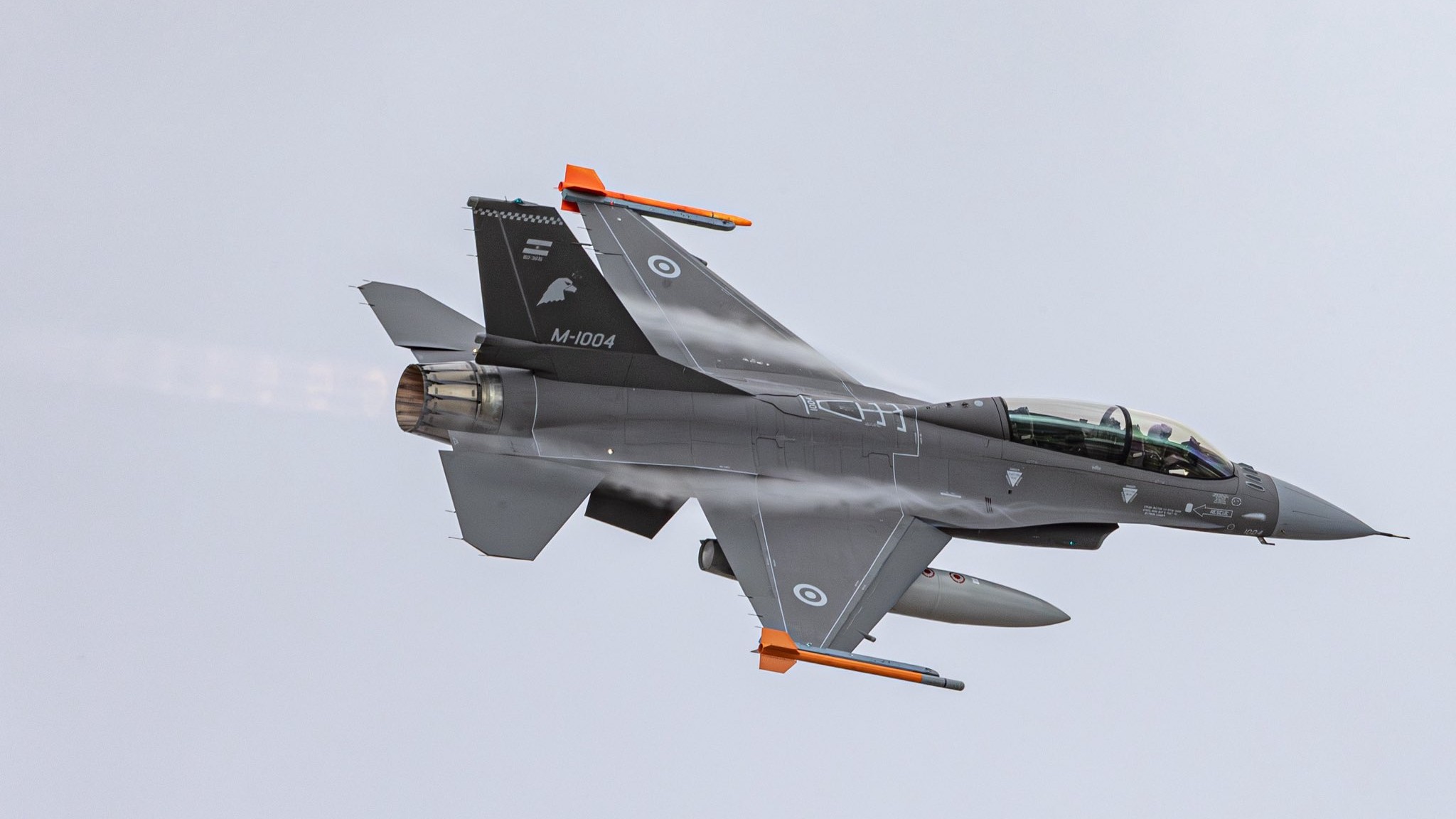
Eventually, as surplus F-16s became available from European nations, Argentina was able to negotiate a deal through the U.S. for some of these aircraft. Secret talks apparently took place between the U.S. and UK, where the former pressured for the UK to not object to the deal. While Argentina’s still active dispute over the Falkland Islands – administered by the UK – continues, the bigger geopolitical concern was feared in pushing the South American nation into China’s sphere of influence by denying defence exports.
The only remaining military operator of the A-4 is now the Brazilian Navy, who continue to operate a handful of jets even after the retirement of aircraft carrier São Paulo. Civilian operators continue to fly the Skyhawk in an aggressor role, with aircraft active on both the U.S. and Canadian civilian registers.
KC-135s?
To support its new fleet of F-16s, which require boom-equipped tankers, Argentina is reported to be seeking the acquisition of used KC-135 Stratotankers.
Two aircraft are apparently desired for the Fuerza Aérea Argentina, with the most likely donor being the U.S. Air Force. However, the intense pressure on USAF tanker forces shown by recent operations as well as the loss of multiple aircraft in the fleet raise questions over whether such a transfer would be authorised.
An alternative option might be to take after India, who have contracted a privately owned KC-135 to supplant its troubled Il-78MKI Midas tankers during training operations. However, such a contract would almost certainly allow only for training operations and not for support during live combat missions, which places limitations when Argentina has no alternative – even a problematic one – to fall back on.
Boosting their new F-16s’ range with KC-135s is also likely to draw opposition from the United Kingdom, as the Falkland Islands would be brought within range of significant Argentinian air power once again. The islands are currently defended from the air by a detachment of four Eurofighter Typhoon FGR4s along with a Sky Sabre battery.
A classy view of “Faith”, a Eurofighter Typhoon from RAF’s famous 1435 Flight based at Mount Pleasant, #Falklands. 1435 Flight operates four Typhoons, named “Hope”, “Faith”, “Charity” and “Desperation”- in the best of Maltese tradition of #WWII. #avgeeks #aviation #RAF pic.twitter.com/JtWGKPMqJm
— Air Power (@RealAirPower1) February 1, 2022
Argentine A-4s in the Falklands War
Though the specific jets that took part have long since been retired, the 1982 Falklands War is arguably the most famous period for Argentina’s A-4s. Along with Dassault-Breguet Super Étendard and IAI Dagger, A-4 Skyhawks were employed to the very edge of their range capabilities to attack British forces with a devastating effect.
Skyhawks scored hits with unguided bombs on HMS Glasgow, HMS Antelope, HMS Ardent, HMS Argonaut, HMS Broadsword, HMS Coventry, RFA Sir Bedivere, RFA Sir Galahad, and RFA Sir Tristram. Of these, HMS Coventry and HMS Ardent were totally destroyed, while RFA Sir Galahad was severely damaged and eventually scuttled. Further attacks took place against British ground forces.
#OTD in 1982 the Royal Navy lost its last warship to enemy action when HMS Coventry was hit by bombs off the Falklands, killing 20 souls. Coventry had already accounted for at least 2 enemy jets amidst an all-out effort by Argentine pilots against the RN on their national day. pic.twitter.com/oU0MLAZ3VB
— Royal Navy (@RoyalNavy) May 25, 2023
The 231 A-4 sorties flown took a heavy toll, with 22 aircraft lost – the majority to enemy fire, including air to air shootdowns by Sea Harriers, surface to air missiles fired from Royal Navy vessels, and some to anti-aircraft gunfire.


