

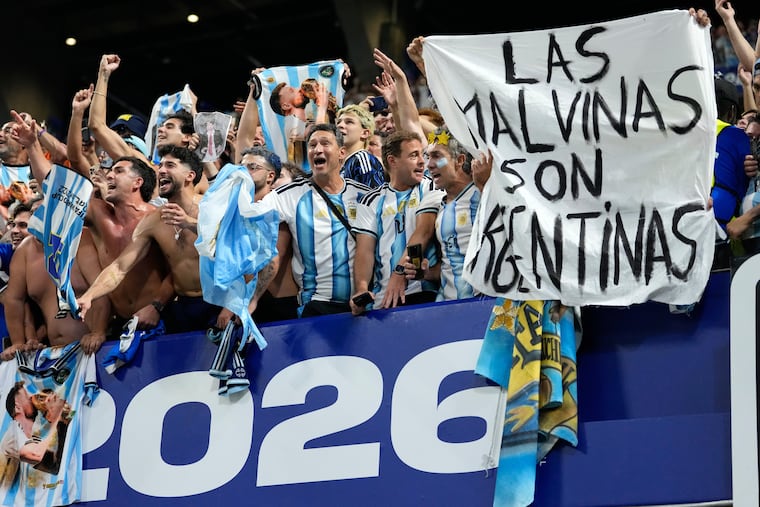
In July, Argentina defeated England 2-1 in the 2026 World Cup semifinal. Argentine players celebrated the victory on the field, unraveling a banner that read, “Las Malvinas son argentinas” [The Malvinas are Argentine].
The slogan invoked Argentina’s longstanding claim to the South Atlantic islands, over which the country had gone to war with the United Kingdom in 1982. The UK refers to this territory as the Falkland Islands, but Argentina disputes this name in favor of Malvinas.
The gesture drew criticism from the UK, and Argentina’s President Javier Milei demanded that his countrymen not mix football with politics. “We shouldn’t fall for cheap, populist, nationalist, and rancid slogans,” he announced on Radio Mitre.
Just months later, Milei made the slogan his own.
“The Malvinas are Argentine, by history and rights,” he declared in a televised address on Sept. 3. He announced plans to sanction foreign companies involved in oil exploration around the islands and proposed measures to strengthen Argentina’s ability to defend its national sovereignty.
The president’s reversal on the Malvinas is striking but falls into a broader political pattern. Facing political tension at home, nationalist leaders often turn to territorial disputes to project strength and rally patriotic support. Vladimir Putin’s invasion of Ukraine, Donald Trump’s aspirations to Greenland, and Xi Jinping’s claims over Taiwan all fit this playbook. In Argentina, presidents have long turned to the islands as a source of national unity, particularly when confronted with domestic problems.
The Malvinas took on new political urgency in the 1960s, when the United Nations recognized the sovereignty dispute within its broader decolonization framework.
The UN’s call for peaceful negotiations between the UK and Argentina coincided with the military’s growing influence in Argentine politics. Throughout much of the 20th century, the armed forces repeatedly overthrew democratic governments. This cycle culminated in progressively longer and more violent dictatorships. After Juan Perón’s death in 1974, escalating violence between rival Peronist factions paved the way for a 1976 coup, amid a wave of U.S.-backed military regimes across Latin America.
The 1976 dictatorship promised to restore order and economic stability but failed to deliver. Over the next six years, the junta’s economic policies led to deindustrialization, rising unemployment, and deepening poverty. Inflation remained in the triple digits every year except 1980, and Argentina’s foreign debt surged from $8 billion to $45 billion. Alongside these austerity measures, the junta’s political repression resulted in thousands of deaths and disappearances.
By 1982, the military’s hold on power had weakened as the economy plunged into a deep recession. Strikes and protests became more frequent as Argentines denounced soaring inflation and massive human rights abuses. On March 30, the General Confederation of Labor called a general strike — the first since 1975 — and thousands gathered in Buenos Aires to demand “peace, bread, and work.” Federal police responded by arresting more than 2,000 protesters.
To bolster popular support for an increasingly fragile regime, military dictator Leopoldo Galtieri invoked the Malvinas. On April 2, the junta invaded the islands, which Britain had controlled since 1833. The regime framed the invasion as a “recovery” of Argentine territory and urged citizens to rally behind the national cause. The generals hoped to redirect public anger toward a longstanding territorial claim and to unite Argentines behind the dictatorship.
For a time, the strategy worked. Argentines gathered in Plaza de Mayo to celebrate the invasion, transforming the space where police had violently suppressed protesters only days earlier into a scene of patriotic celebration.
However, the junta had badly miscalculated, and Britain retook the islands in June. The swift defeat exposed the Argentine generals’ inability to coordinate planning and action and left more than 600 dead and over 1,600 wounded. The Malvinas War weakened the regime and ultimately accelerated its collapse. Within months, the military announced democratic elections for 1983.
The Malvinas defeat discredited the junta but did not diminish Argentines’ patriotic fervor for the islands. Instead, the return to democracy created space for Argentine governments to distinguish the legitimacy of the sovereignty claim from the illegitimate junta that had pursued the invasion.
In 2012, President Cristina Fernández de Kirchner turned to the Malvinas amid soaring inflation, rising capital flight and a growing energy deficit. After she won reelection with 54% of the vote in 2011, her second term marked a shift toward more explicitly nationalist politics. In April 2012, Fernández de Kirchner expropriated a controlling stake in the Spanish-owned oil company, YPF. She directly linked this move to the renewed claim to the Malvinas and posters declaring, “The Malvinas and YPF are Argentine” littered the streets.
Speaking on the 30th anniversary of the Malvinas War, Fernández de Kirchner explicitly rejected the junta’s 1982 actions while venerating the veterans’ sacrifices. The junta had been wrong to attempt “to perpetuate itself in power,” she argued. Yet she framed Argentina’s sovereignty claim over the islands as part of her own administration’s efforts in support of memory, truth, and justice for the dictatorship’s crimes. Those efforts included reopening trials against those responsible for torture, disappearances, and other human rights abuses committed during the dictatorship.
Adopting the language of the human rights movement, Fernández de Kirchner identified British control of the islands as an enduring colonial injustice. This discourse allowed her to claim the Malvinas as a national and patriotic cause while disavowing the dictatorship that had waged the war. The Malvinas thus offered a powerful symbol to connect territorial sovereignty, economic independence and a democratic reckoning with the past.
In September 2026, President Milei has drawn similar connections between sovereignty and resource extraction as Argentina clashes with Britain over the planned Sea Lion oil project.
The project, operated by British company Rockhopper and Israel’s Navitas Petroleum, could begin producing oil as early as 2028, turning the longstanding territorial dispute into a more immediate struggle over access to valuable natural resources. As Fernández de Kirchner did with YPF, Milei has framed control over natural resources as inseparable from national sovereignty.
Milei’s shifting approach to the Malvinas accompanies his bid for reelection in 2027. Since his election in 2023, inflation has fallen dramatically, but his administration’s economic record remains deeply contested. Unemployment has grown and real wages have weakened, driving discontent with the government’s austerity measures. The president’s approval ratings have fallen to 38% in recent months.
As domestic tensions rise, the Malvinas once again offers a patriotic cause capable of rallying support across political divides. Various governments have pursued radically different strategies to recover the Malvinas, yet each found in the territorial dispute a powerful language of national sovereignty and anti-colonialism.
When Argentina’s players held up a banner after defeating England, they were not pushing a foreign-policy agenda. They were drawing on a decades-old expression of national identity that has come to encompass Argentine sovereignty, resistance to colonialism, and perhaps most importantly the memory of los pibes de Malvinas, the young men sent to war in 1982.
The Malvinas remain politically useful not because Argentines have forgotten the war or its devastating consequences, but because those memories have become part of what the islands represent. The players’ banner resonated for the same reasons: the fight for the Malvinas has become part of what it means to be Argentine.
Gabrielle Esparza is a historian of Latin America, specializing in transitional justice and democratization in Argentina.
Made by History takes readers beyond the headlines with articles written and edited by professional historians. Opinions expressed do not necessarily reflect the views of The Inquirer.


