



Matthew Smith
Matthew Smith is Oilprice.com’s Latin-America correspondent. Matthew is a veteran investor and investment management professional. He obtained a Master of Law degree and is currently located…
Set us as your preferred Google source
Premium Content
By Matthew Smith – Feb 14, 2026, 6:00 PM CST
- Argentina hit record crude production of 861,380 bpd in December 2025, driven primarily by shale output from Vaca Muerta.
- Shale oil now accounts for 69% of total crude production, while shale gas represents 65% of national gas output.
- Massive investment plans, including YPF’s $36 billion spending program and growing foreign participation, are positioning Argentina as a long-term energy growth story.
The massive unconventional oil boom underway in Argentina continues to gain momentum. During late 2024, Argentina, which is South America’s second largest economy after Brazil, overtook Colombia to become the continent’s fourth largest oil producer. The surge in petroleum revenues, coupled with President Javier Mieli’s economic reforms, is a boon for one of the world’s most unstable and crisis-riven economies. There are signs of strong production growth ahead with shale oil and gas output expanding at a solid clip.
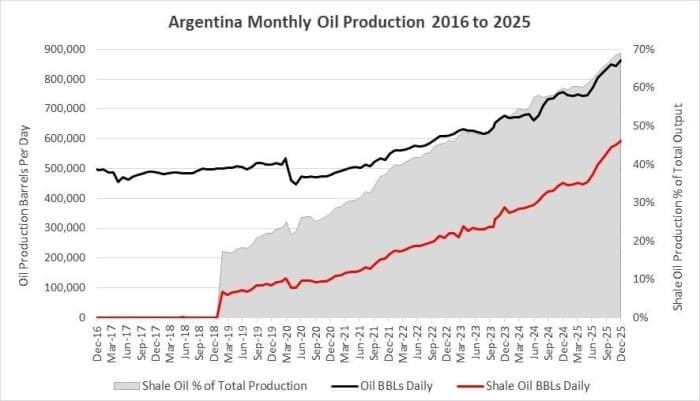
Government data shows that for December 2025, Argentina pumped a record of 861,380 barrels of crude oil per day. This was 2% greater than a month earlier and an impressive 14% higher year over year. As the chart illustrates, that solid number is nearly double the 494,721 barrels per day lifted for the same period a decade ago.
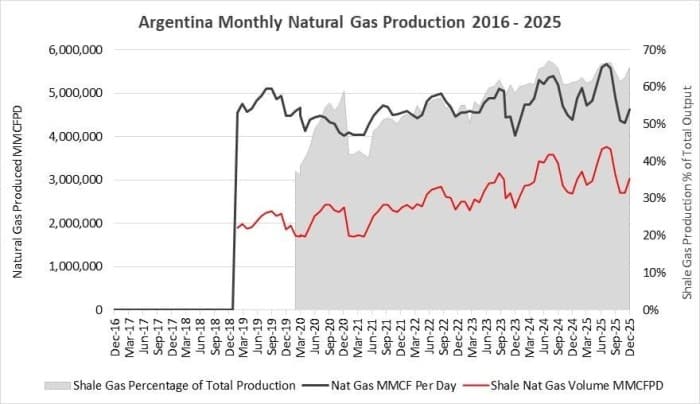
Natural gas production has also grown significantly over the last decade. December 2025 output of 4.6 billion cubic feet per day was 7.4% higher than a month prior and 5.7% greater than the same month a year earlier, although that number is still below recent historical highs. As the chart below shows, December 2025 natural gas output is well below the record monthly high of 5.7 billion cubic feet per day reported for July 2025.
It is rapidly growing shale oil and gas production, which is responsible for the impressive expansion of Argentina’s hydrocarbon output. The successful exploitation of the 8.6-million-acre Vaca Muerta shale formation is responsible for this strong growth in hydrocarbon output, particularly with production from Argentina’s higher-cost mature oil fields declining.
The rapid growth of unconventional hydrocarbon production in Argentina is occurring despite the naysayers asserting a lack of investment, infrastructure, and expertise is curbing production growth. Government data shows December 2025 shale oil production hit an all-time high of 593,488 barrels per day, with it making up a record 69% of all petroleum lifted. That was 0.6% greater than a month prior and 31% higher year over year, while being more than several thousand times greater than a decade earlier.
A similar phenomenon is occurring with shale gas. For December 2025, Argentina’s shale gas production of 3 billion cubic feet per day represented a 12% increase when compared to both a month and a year earlier. Although it is 18% lower than the all-time high of just under 3.8 billion cubic feet reported for July 2025. Nonetheless, December 2025 shale gas output was still responsible for 65% of Argentina’s total natural gas production.
There are signs of significant shale gas production growth ahead, particularly with the Vaca Muerta now the engine room for Argentina’s fossil fuel output. It is Argentina’s national oil company, YPF, which is the leading developer and producer of hydrocarbons in the Vaca Muerta. The driller is 51% owned by Argentina’s state and federal governments after it was nationalized by President Cristina Fernández de Kirchner in April 2012. YPF plans to become a pure unconventional oil and gas company by the end of the decade.
The national oil company for December 2025 lifted 384,397 barrels per day, representing 55% of Argentina’s total petroleum production for that month. Of that total petroleum output, 86%, or barrels per day, was shale oil pumped from the Vaca Muerta. YPF’s natural gas output for that period was 947,191 million cubic feet per day, which represents 20% of Argentina’s total production of the fossil fuel for December 2025. Shale gas comprised 80% of YPF’s total natural gas production for the period, underscoring how the company is rapidly moving to a pure play shale oil and gas driller.
YPF expects production to grow at a solid clip. Not only is the development of the company’s Vaca Muerta acreage at an early stage of development but the integrated energy major plans to spend nearly $36 billion between 2025 and 2030. According to the company, drilling will peak in 2029 with 32 active drill rigs. This will drive higher production with YPF estimating total hydrocarbon output of 1 million barrels of oil equivalent per day, nearly double the 553,009 barrels produced during December 2025. That will be 47.5% weighted to crude oil, with the remainder comprised of natural gas (440,000 barrels) and natural gas liquids (75,000 barrels).
Other energy companies are investing heavily in the Vaca Muerta. Hydrocarbon investment for 2026 is expected to reach $11 billion, a 17% increase over $9.4 billion for 2025. Most of that capital will be directed toward the Vaca Muerta shale play. The hydrocarbon-rich geological formation, which contains an estimated 16 billion barrels of shale oil and 308 trillion cubic feet of shale gas, is attracting considerable attention from Big Oil. Supermajor Shell, which recently dismissed speculation that the company was planning to divest its Vaca Muerta assets, committed to spending $700 million on the shale play during 2026.
Colombia-headquartered independent oil and gas producer GeoPark recently secured $50 million of financing to develop acreage in the Vaca Muerta. The company previously announced plans to invest in developing the Loma Jarillosa Este and Puesto Silva Oeste Blocks, which were purchased from Pluspetrol during September 2025. This signals the entry of another intermediate exploration and production company in the Vaca Muerta, underscoring the shale play’s solid economics, with the average breakeven price as low as $36 per barrel, which makes it attractive for smaller drillers.
The rapid development of the Vaca Muerta not only reversed Argentina’s crippling energy deficit, which hit an all-time high of $7 billion during 2013, but has made the crisis-prone country a net energy exporter. That, along with President Javier Milei’s economic shock therapy, where fiscal spending was slashed, and the currency stabilized through a managed floating rate, is delivering a massive economic dividend for Argentina. The president’s plans to reduce regulation while removing strict currency and capital controls will drive further foreign investment, particularly for the Vaca Muerta, which is the engine room of Argentina’s hydrocarbon sector.
By Matthew Smith for Oilprice.com
More Top Reads From Oilprice.com
- Tony Blair Think Tank Calls For North Sea Oil Revival
- Venezuela Oil Revenue Projected to Hit $5 Billion Under U.S. Control
- Indian Scrapyards Welcome Growing Number of Dark Fleet Tankers
Download The Free Oilprice App Today


Matthew Smith
Matthew Smith is Oilprice.com’s Latin-America correspondent. Matthew is a veteran investor and investment management professional. He obtained a Master of Law degree and is currently located…


