

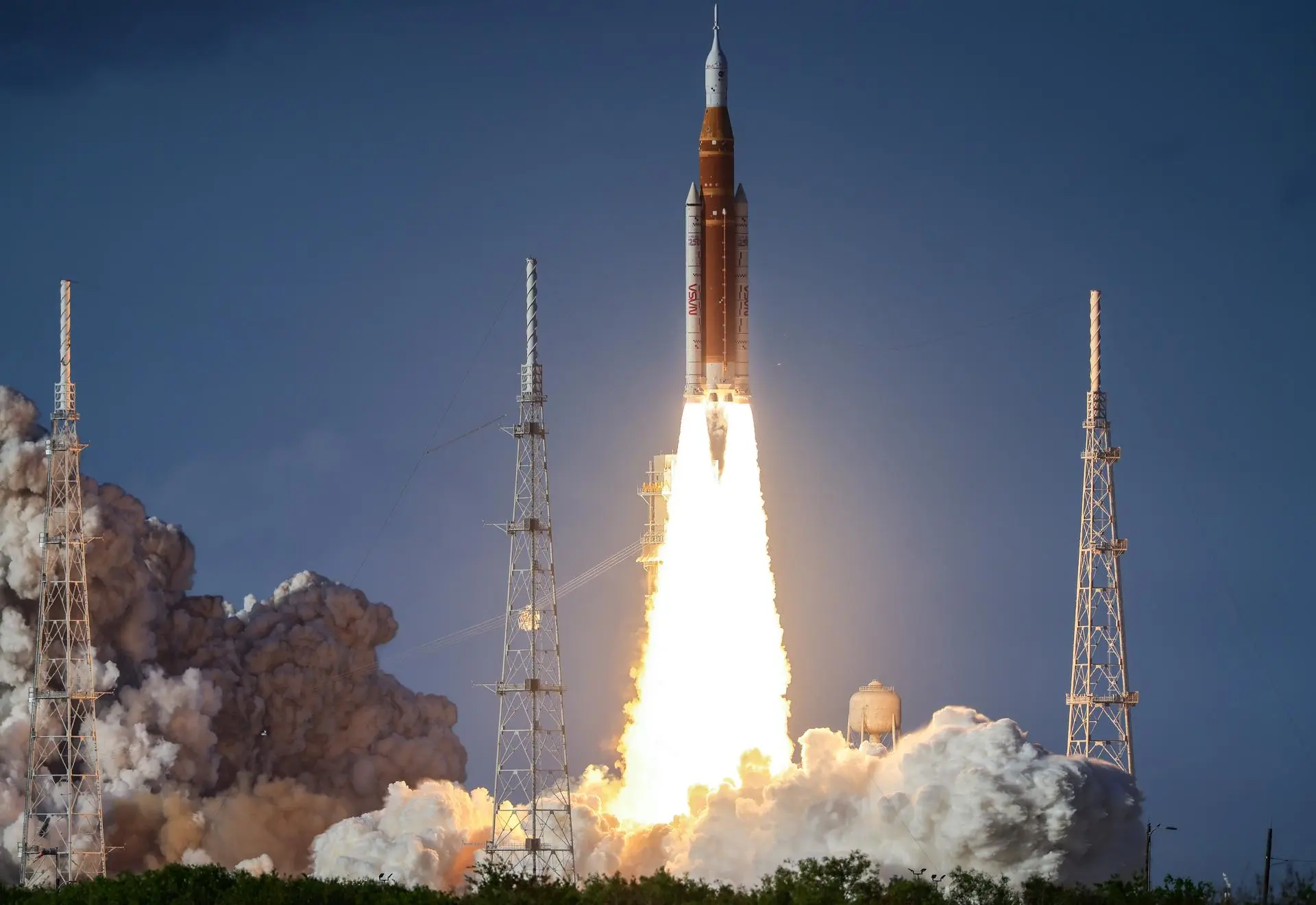

The Space Launch System (SLS) rocket carrying the Orion capsule for the Artemis II mission lifts off from Launch Pad 39B at the Kennedy Space Center in Florida on April 1st. Photo: EFE.
April 2, 2026 Hour: 10:28 pm
🔗 Comparte este artículo
Argentina’s historic leap into space exploration sees its ATENEA microsatellite, participate in NASA’s Artemis II mission, the first crewed lunar flight since Apollo.
NASA initiated a new era in space exploration on Wednesday, April 1, with the launch of the Artemis II mission. This pivotal mission marks the first crewed flight around the Moon since the iconic Apollo program, signifying a crucial step towards sustained lunar presence.
In this context, Argentina holds a direct and significant role through its microsatellite, ATENEA, a national development that embarked as part of the mission’s scientific payload.
The launch, precisely scheduled for yesterday, April 1, from the Kennedy Space Center in the United States, heralded the return of human missions to the lunar environment. The Orion spacecraft is slated for an approximate ten-day test flight. During this period, not only will critical life support systems be rigorously evaluated, but also various scientific instruments will be strategically deployed.
Among these instruments, four advanced CubeSats stand out. One of these is ATENEA, a testament to Argentinean innovation, developed in a remarkably short period of just 18 months. This rapid progress was achieved through a collaborative effort involving several public institutions and leading universities across the nation.
Text reads: “ATENEA, the Argentinean satellite that flew to the moon on NASA’s Artemis II mission, is functioning properly.”
ATENEA is a compact microsatellite, roughly equivalent to two shoeboxes stacked together, yet it carries exceptionally ambitious technological objectives. Its creation resulted from a significant collaborative endeavor, primarily led by the National Atomic Energy Commission (CNEA, in Spanish). Key contributions also came from the University of Buenos Aires, the National Commission for Space Activities (CONAE, in Spanish), VENG S.A., the Argentinean Institute of Radioastronomy (IAR, in Spanisg), the National University of La Plata (UNLP, in spanish), and the National University of San Martín (UNSAM, in Spanish).
Within this comprehensive framework, the Faculty of Engineering at the University of Buenos Aires played an indispensable and central role in the development of several critical components for the microsatellite. These included the external battery charger, the internal radiation meter, and a significant portion of the primary scientific experiment, showcasing the university’s advanced capabilities in aerospace engineering.
ATENEA Aspects
The Argentine satellite is not alone on its journey; it travels alongside three other international CubeSats: TACHELES from Germany, K-RadCube from South Korea, and Space Weather CubeSat-1 from Saudi Arabia. All these miniaturized satellites are transported within the Orion Stage Adapter, a crucial structural component that connects the Orion capsule with the powerful SLS rocket.
Once in flight, these microsatellites will be automatically released at an astounding altitude of approximately 70,000 kilometers from Earth. This deployment altitude will establish an unprecedented record for Argentine space activity, far surpassing the habitual orbits where national satellites typically operate. This achievement underscores Argentina’s growing technical prowess and its capacity to contribute to ambitious deep space missions.
The principal objective of ATENEA in space is the rigorous validation of critical technologies. These technologies are indispensable for future space missions, particularly those operating in environments far more demanding and extreme than the relatively benign low Earth orbit.
One of ATENEA’s key experiments involves attempting to capture GPS signals from an altitude significantly higher than that of the navigation satellites themselves. This represents a substantial technical challenge, and its success could profoundly enhance positioning systems for subsequent deep space exploration endeavors, providing more accurate and reliable navigation far from Earth.
Furthermore, the microsatellite will meticulously analyze space radiation using specialized silicon sensors. These crucial studies aim to elucidate how radiation impacts both electronic components, vital for spacecraft longevity, and simulated biological materials. Such information is absolutely fundamental for ensuring the safety and well-being of astronauts embarking on prolonged space missions, mitigating risks associated with radiation exposure.
Another central aspect of ATENEA’s mission is advanced communication. The microsatellite will strive to validate long-range communication links with terrestrial ground stations under conditions where signals are expected to be exceedingly weak. This will test the robustness and efficiency of new communication protocols, paving the way for more reliable and data-rich transmissions from future deep space probes and crewed missions.
Argentina’s participation through ATENEA thus contributes significantly to the global effort in advancing space exploration capabilities.
Author: Laura V. Mor
Source: Pagina 12/ Tiempo Argentino
IN THIS ARTICLE


