

Round anniversaries invite stocktaking. This year marks fifty years since Argentina’s last military coup. To understand what is at stake today, it is worth briefly revisiting how previous anniversaries were lived and interpreted.
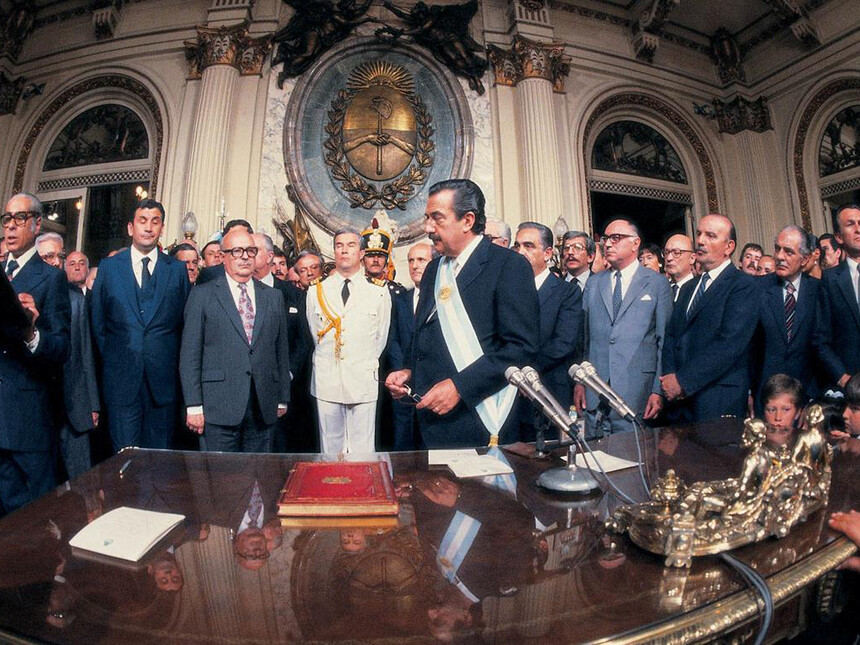
In 1986, Raúl Alfonsín was president, and his administration was still enjoying a degree of political momentum. Yet on March 24, human rights organizations closely linked to the families of the disappeared—most notably Abuelas de Plaza de Mayo and Madres de Plaza de Mayo—took to the streets to demand harsher judicial action against former repressors.
The Trial of the Juntas had been historic, but it was also limited. Those limits were later reinforced by the Law of Due Obedience (Ley de Obediencia Debida) and the Full Stop Law (Ley de Punto Final), passed in 1986 and 1987. Alfonsín’s human rights policy deserves an article of its own; for present purposes, it is enough to say that because the crimes of the dictatorship had been carried out clandestinely and on a massive scale, the democratic justice system was quickly overwhelmed. Argentina’s newly restored democratic institutions were placed under severe strain. Alfonsín ultimately paid the political price of imposing limits to preserve democracy itself.
The 1990s were defined by Menem-era impunity, amnesties, and a deliberate attempt to erase the past. The human rights movement became one of the most persistent and visible opponents of Carlos Menem. By the twentieth anniversary of the coup, the March 24 demonstration had turned into a massive opposition march. A new political actor also emerged: the children of the disappeared, who brought their own voice and demands into the public arena.
In 2006, Néstor Kirchner was in office. That year, March 24 was declared a national holiday and incorporated into the school calendar. For the first time, a sitting president publicly identified himself with the disappeared, referring to them as “comrades in militancy” and giving human rights organizations a central place in official commemorations. That closeness to power would later become a source of controversy. Today, anti-Peronist sectors frequently seek to discredit Abuelas and Madres by pointing to their proximity to the Kirchners.
When the fortieth anniversary arrived in 2016, Mauricio Macri had been president for only four months, and March 24 coincided with an official visit by Barack Obama. The left and Peronism were united in outrage. It is fair to concede that hosting, on the day of commemoration, the president of the empire that had backed coups across the region was, at the very least, an unsettling gesture.
Today, fifty years after the coup, Argentina is governed by a president who regularly displays his contempt for democracy. While the proposal to reopen cases against former guerrilla fighters has been completely abandoned, the government released a video lasting over an hour that, within its first minute, invokes the idea of “complete memory” and denounces what it describes as Kirchnerist uses of the past. Javier Milei may claim to have moderated his tone—an assertion contradicted by his speech opening Congress on March 1—but he makes no effort to disguise who he is.
At the same time that he denounces Kirchnerist corruption, Milei does not shy away from his own contradictions. He continues to support his most beloved minister, Manuel Adorni, despite documented inconsistencies between Adorni’s declared income and his spending on property purchases, private flights, and other expenses. Weren’t these precisely the excesses of the political “caste” that Milei promised to eradicate? In Argentina, it seems, the past teaches nothing to anyone.
The dictatorship did not begin on March 24, 1976. That coup was the last in a long series of military interruptions that had plagued the country since 1930. Before 1976, the state’s response to political conflict had been repressive, and since 1973, paramilitary groups had already been assassinating militants.
What set the 1976 dictatorship apart was its decision to carry out a nationwide, clandestine extermination of political opponents, establishing forced disappearance as a systematic practice. Those who call for “the whole truth” demand that attacks by left-wing organizations also be remembered—as if that could somehow lessen the gravity of a state that turned its machinery against its own citizens.
Nor did the dictatorship end on December 10, 1983. I am not referring here to its long-term effects, but to entrenched practices that proved difficult to dismantle, particularly within the armed forces and security services. My father completed his mandatory military service in 1984, when officers told conscripts that “democracy only applies outside the barracks.”
Even today, nostalgic defenders of the regime insist that all social problems would be solved if young people were forced back into military service. Discipline and willpower, they argue, are the cure for everything—or at least that is what the wealthy believe the poor should be subjected to.
I remember the day Milei won the election. A friend sent me a voice message, crying, saying, “We learned nothing from the dictatorship.” She was right. But it is also true that we have consistently failed to explain the dictatorship properly, whether in the media or in schools, and that every democratic government has instrumentalized the recent past to suit its needs. Following the classic distinction proposed by Tzvetan Todorov, Argentina has always clung to literal memory, never exemplary memory. The past has been preserved to legitimize political struggles, not to extract lessons for the present.
Writer Mariana Enriquez has offered a particularly illuminating reflection in interviews. She is interested in exploring, through fiction, the years when Alfonsín’s government was already defeated. By 1987, the initial euphoria had faded, and the democratic spring had turned into a long, burning summer. Those were Enriquez’s teenage years—a period she describes as deeply punk, marked by a deep sense of “no future.”
The economic crisis had become so acute that power outages were daily, prices rose by the hour, and adults were too overwhelmed, materially and psychologically, to look after children and adolescents. For those born in the 1960s, adulthood arrived amid economic and political instability, without the experience of a stable democracy, and with parents caught in a downward spiral of precarity.
This context matters. While it is true that we have failed to transmit the meaning of the dictatorship to younger generations, it is also true that the vote for Milei cannot be explained solely as a rightward shift. It is equally an expression of widespread exhaustion with ineffective economic and political models. Argentine society no longer knows how to respond to a permanent economic crisis—one whose causes are so longstanding that it resembles a chronic illness. Forgive the organic metaphor, which I despise. All we know is that, if by chance you have a few spare pesos, the safest option is to buy dollars.
Alfonsín famously declared that “with democracy, you can eat, you can heal, and you can be educated.” That promise was not fulfilled. As political scientist Andrés Malamud argues, democracy today will not die in a coup; it will slowly agonize as it fails to meet society’s basic needs, collapsing without taking everyone down at once. And as Enriquez aptly notes, when the country breaks, we break with it. I can attest to that from the 2001 crisis.
Paraphrasing Pierre Bourdieu, the paradox of the social sciences is that people do not need them in everyday life. Drawing on their own experiences and trajectories, individuals develop their own ideas about the state, society, why they fail, and how they might be improved. That is why it ultimately matters little how many books, papers, university courses, films, or novels are produced about the “great horror” of 1976 if, day after day, democracy shows its most corrupt and bureaucratic face to the generation now entering political life.


