

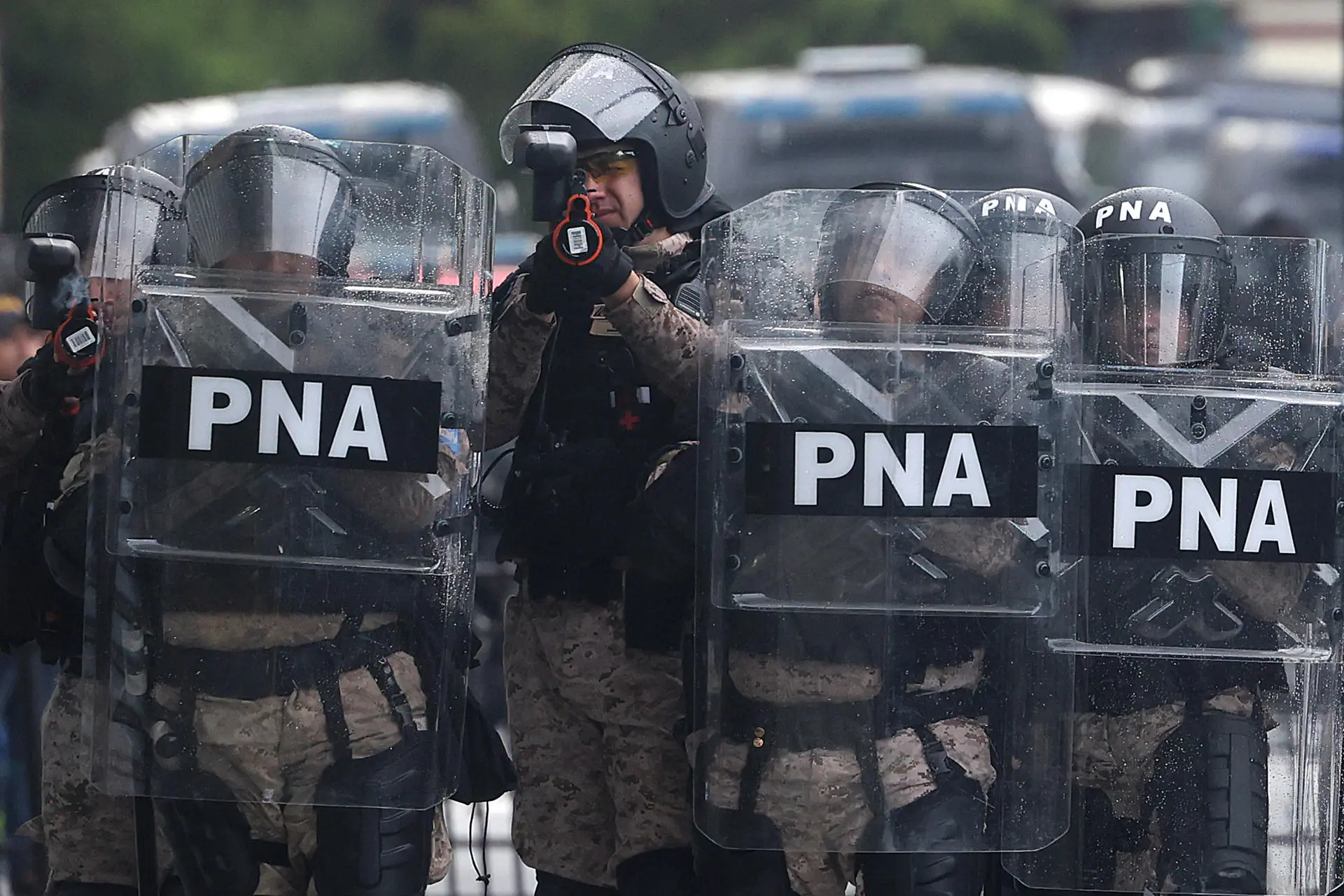
Argentina’s Provincial Commission for Memory has filed a criminal complaint against the Milei government and security officials over alleged police abuses during a university protest in Buenos Aires. The organization reports at least 550 people required medical attention and is seeking an independent investigation.

Security forces confront demonstrators during the October 16 Federal University March in Buenos Aires, where hundreds reportedly required medical attention. Photo: EFE
October 18, 2026 Hour: 3:34 am
🔗 Comparte este artículo
The complaint alleges excessive force during an October 16 university protest in Buenos Aires, where at least 550 people required medical attention.
Argentina’s Provincial Commission for Memory (CPM) has filed a criminal complaint against President Javier Milei’s government and security officials over a police crackdown on a university protest in Buenos Aires that left at least 550 people requiring medical attention. The filing accuses security forces of abuse of authority, dereliction of official duties and other crimes.
RELATED: Argentina Abstains on UN Colonialism Vote Despite Malvinas Rhetoric
The complaint concerns the October 16 Federal University March and a demonstration against Decree of Necessity and Urgency (DNU) 70 in Plaza del Congreso. It names the Unified National Security Command and authorities in the Autonomous City of Buenos Aires, alleging that the security operation exceeded legal limits.
The operation involved the Federal Police, Naval Prefecture, National Gendarmerie, Airport Security Police and Buenos Aires City Police. According to the CPM, officers intervened while the mass demonstration was underway, forcing university leaders to interrupt their reading of the main statement from the stage.
The commission reported that officers fired rubber bullets directly at protesters’ faces and heads and used water-cannon trucks against demonstrators. At least 550 people required medical attention, and at least 120 tear-gas grenades were fired, according to the organization.
Journalists and human rights monitors injured
A CPM report documented injuries to 50 media workers and 15 members of the commission, which is chaired by Adolfo Pérez Esquivel and Dora Barrancos.
Among those injured were Página/12 photographer Guido Piotrkowski, who was struck twice in the chest by rubber bullets, and TeleSISA journalist Laura Quispe, who sustained nine rubber-bullet impacts.
Footage circulated by the Center for Legal and Social Studies (CELS) showed officers aiming at protesters’ eyes. Later that evening, television cameras recorded Gendarmerie officers collecting spent cartridges from the streets and placing them in bags. The CPM raised concerns about the preservation of potential evidence.
Six people arrested during the demonstration
Six people were arrested during the protest and its dispersal. Two students from Nicolás Avellaneda School were detained at 5:11 p.m. at the intersection of Montevideo and Sarmiento streets.
One student, aged 14, was held for two hours. The other, aged 17, was charged with resisting authority and faces criminal proceedings under the recently introduced juvenile justice regime.
Police later arrested four adults — three men and one woman — at the intersection of Chacabuco Street and Avenida de Mayo. Human rights organizations said the woman, a student at the National University of Tres de Febrero, was stopped because she was carrying a Colombian flag. All four were charged with resisting authority.
Commission seeks records and independent investigation
The CPM’s complaint alleges that the actions of officers and their political superiors were coordinated and carried out under orders from senior officials who knowingly authorized the use of coercion outside the legal framework and in violation of Argentina’s international commitments.
The commission has asked the national and Buenos Aires city security ministries to provide a complete list of personnel deployed during the operation, details of the vehicles, weapons and equipment used, and copies of orders transmitted over police radio frequencies.
It is also seeking information about officers who photographed or filmed protesters, including whether they had prior judicial authorization, as well as footage from the city’s surveillance cameras.
The CPM has called for independent forensic examinations and for the collection, custody and analysis of testimony, commercial recordings and other evidence to remain under the control of the competent court or prosecutor. The request specifically excludes the security forces implicated in the events from handling that evidence.
IN THIS ARTICLE


