


The Briefing:
- Private consultancy ExQuanti estimates Argentina’s poor population grew from 13.4 million people in the second half of 2025 to 15.1 million in the first half of 2026 — a jump of 1.7 million in six months, as first reported by La Nación.
- Private projections put the poverty rate somewhere between 29% and 31.6%, well above the prior semester’s 28.2%, marking what would be the first six-month increase since Javier Milei took office.
- Argentina’s national statistics agency, INDEC, releases its official household survey figures on September 24, while formal private-sector employment has now contracted for 13 straight months.
A reversal nobody saw coming
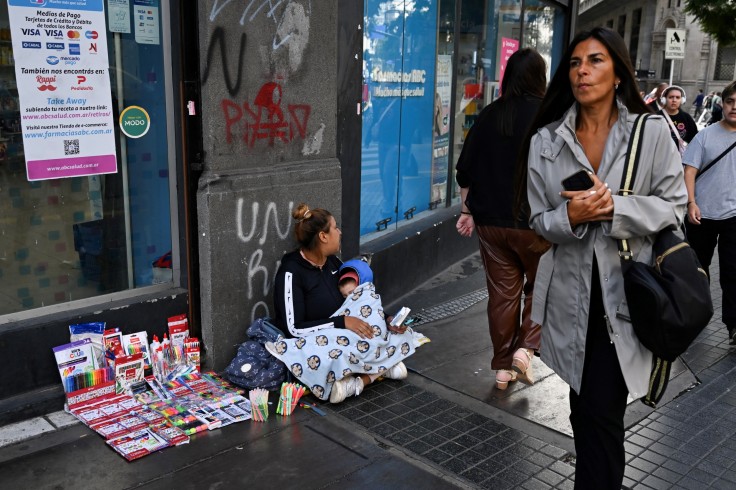
Poverty in Argentina had been falling almost without interruption through most of 2025. That trend broke in the final months of the year, and if private estimates hold up, the first half of 2026 would mark the administration’s first semester-over-semester setback: the official rate of 28.2% would climb into a range of roughly 29% to just over 31%, according to El Economista. Measured from the low point reached late last year rather than semester-to-semester, the cumulative increase would be even steeper — an estimated 2.9 million people crossing the poverty line.
Different numbers, same direction
No two economists agree on the exact figure, but none dispute where the trend is headed. Martín González Rozada, an economist at Torcuato Di Tella University, puts the semester’s rate at 31.6%, the highest reading among the group. At the Catholic University’s Observatorio de la Deuda Social, Agustín Salvia has argued that poverty “stopped declining” as far back as late 2025, a reading his institute has stood by through two consecutive quarters. Cedlas researcher Leopoldo Tornarolli expects the rate to climb “a couple of points” versus the previous semester, while Idesa’s Jorge Colina offers the most conservative estimate of the bunch, between 29% and 30%. The spread exists because each group builds its own monthly model to anticipate a number the government hasn’t released yet.
Officials don’t dispute the deterioration, but they frame it as short-lived. They tie it to currency pressure and to price increases that piled up after the legislative elections — an effect they say is only now filtering through to consumer prices with a lag, per reporting from BAE Negocios. The administration’s position is that its fiscal-surplus strategy should speed up disinflation in the coming months, unwinding much of the recent spike.
The job market tells a less reassuring story
That optimistic forecast runs up against a labor market that keeps weakening. Registered private employment has now shrunk for 13 consecutive months, a metric that typically signals pressure on household income well before it shows up in poverty surveys, Prensa Latina reported. More than 354,000 registered payroll jobs have disappeared since November 2023, with manufacturing and construction alone accounting for 60% of that decline, according to figures compiled by Cadena 3. Many of those workers have shifted into self-employment or unregistered jobs that offer neither the stability nor the pay of a formal salary.
Beyond this semester’s spike sits a longer-running problem: median household income in Argentina remains 13% below where it stood in the third quarter of 2017. That gap helps explain why, even as the government touts slower inflation on other fronts, a large share of the population still hasn’t clawed back the purchasing power it lost over nearly a decade.
What to watch on September 24
Everything above comes from private modeling, not an official count. INDEC will publish its own household survey results on September 24, and that figure will ultimately confirm — or narrow — the true scale of the setback. Until then, the 29%-to-31.6% range economists are working with is the best available approximation, with the caveat that every source agrees on the direction of the trend and disagrees only on its size.
© {{Year}} Latin Times. All rights reserved. Do not reproduce without permission.


